

For Anel Akhmetkanova and Gulmira Anayatova, accessible books and technology have opened new opportunities – and a pathway to greater independence.
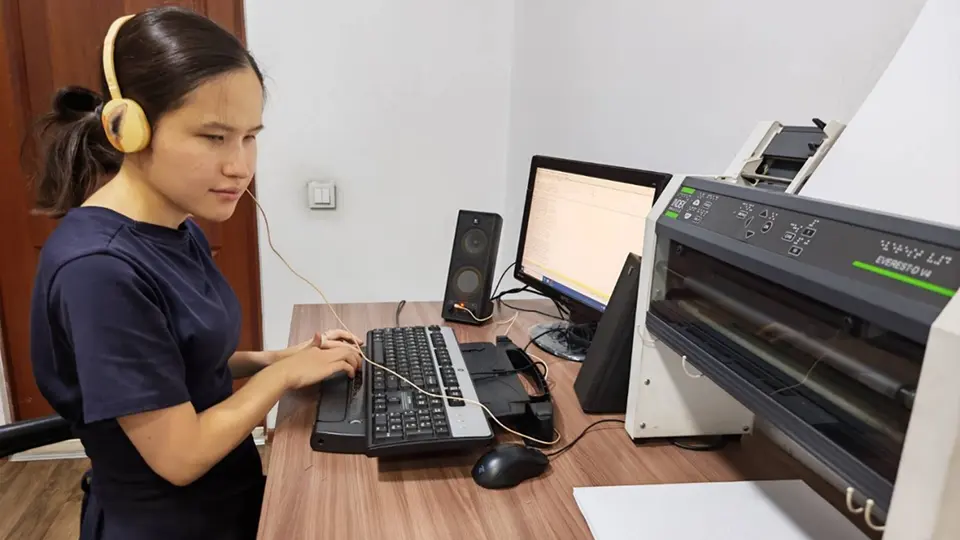
At 24, Anel is building a career around making books accessible to others. But at college, accessible textbooks were scarce, particularly in the Kazakh language.
After graduating, Anel struggled to find work. A friend recommended the rehabilitation center of the Kazakh Society of the Blind (KSB), where she trained and began working as a Braille editor. Today, she proofreads the center’s monthly specialist magazine and has worked on around 50 books.
Through a project between KSB and the World Intellectual Property Organization’s (WIPO) Accessible Books Consortium (ABC), funded by the Government of the Republic of Korea, Anel also learned to use accessible digital textbooks and reading technology.
“I remember feeling a little disappointed,” she said, “because I thought that if digital textbooks had been available when I was at college, studying would have been much easier for me.”
Today, Anel rents her own apartment, covers her own expenses and is preparing for university admission using accessible textbooks produced by her colleagues. She hopes to study publishing and continue producing accessible books.
Her message to other young people who are blind and considering university is one of encouragement:
“Every year, more accessible textbooks are becoming available in Kazakhstan, and they should not be afraid to go to university. The most important thing is to believe in yourself and be willing to take risks.”
Education and access to reading materials are two fundamental things that everyone should be able to enjoy.
We believe that supporting these two elements is crucial to opening up new opportunities and promoting greater independence.
Through MCST's financial contribution (Funds-in-Trust) to WIPO, the Republic of Korea has supported education in 19 countries and the production and conversion of more than 2,600 textbooks into digital accessible formats.
Through these activities, we have supported the implementation of the Marrakesh Treaty.
Inspired by the examples of Anel and Gulmira, we will continue our commitment to ensuring access to education and reading materials, helping people open up new opportunities and fostering greater independence for everyone.
Ministry of Culture, Sports and Tourism of the Republic of Korea
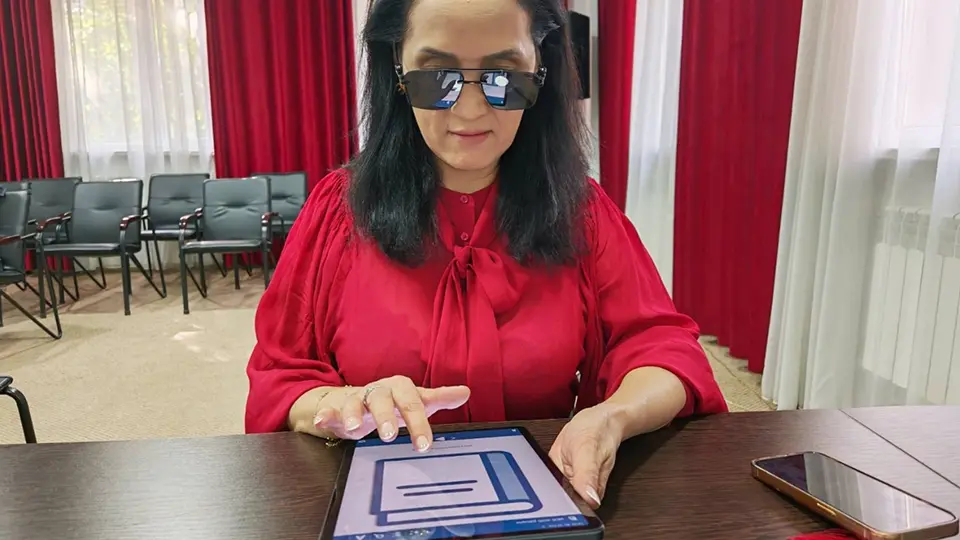
Gulmira’s path began very differently, having lost her sight at 45 following a road traffic accident. A mother of three with a degree in banking and a career in finance, she suddenly faced a very different future.
“I could not imagine a life without sight,” she said. “My social circle became much smaller. I did not want to communicate with anyone.”
Her first visit to the KSB rehabilitation center changed that.
“I met other blind people for the first time. They were independent. They worked and moved around freely on their own,” she said. “There was a sense of freedom.”
Gulmira learned Braille and how to use a computer, began teaching conversational English and eventually became a rehabilitation specialist. Today, she is also studying Adapted Physical Culture at the Academy of Sport and Tourism.
Through the ABC-WIPO project, she learned to use accessible digital textbooks and reading technology in her studies.
“Being able to use a computer, tablet and phone means that I can be completely independent of my classmates and family,” she said. “With assistive technologies, I do not experience any particular difficulties with my studies.”
A project with a wider purpose
Anel and Gulmira’s experiences are part of a broader effort to make higher education more accessible to people who are blind, visually impaired or otherwise print disabled in Kazakhstan.
Funded by the Government of the Republic of Korea and implemented by KSB in collaboration with ABC and WIPO, the project supports the objectives of the WIPO-administered Marrakesh Treaty, which Kazakhstan was the 100th contracting party to join.
The project produced accessible university textbooks while also building the skills needed to produce and use them. KSB staff received training in accessible book production, while students, teachers and librarians learned to use reading devices and applications. KSB estimates that more than 1,000 students with visual impairments could benefit from the textbooks produced.
About ABC
The Accessible Books Consortium (ABC) is a public-private partnership led by WIPO that, together with its many partners around the world, has had real impact over the past decade. Since its inception, the ABC Global Book Service catalogue has quadrupled in size to over one million titles thanks to the inclusion of the collections of participating authorized entities. ABC delivered a total of 240,500 accessible digital files from the ABC catalogue to persons with print disabilities through its authorized entities in 2025. In addition, through ABC’s training and technical assistance partners, more than 24,000 textbooks have been made accessible in over 40 low-income countries, improving access to education for thousands of young people. ABC was established in June 2014 to implement the goals of the Marrakesh Treaty.
About WIPO
The World Intellectual Property Organization (WIPO) is the global forum for intellectual property policy, services, information and cooperation. A specialized agency of the United Nations, WIPO assists its 194 Member States in developing a balanced international IP legal framework to meet society's evolving needs. It provides business services for obtaining IP rights in multiple countries and resolving disputes. It delivers capacity-building programs to help developing countries benefit from using IP. And it provides free access to unique knowledge banks of IP information.